
“Social-First” Means Nothing
(Until You Make It Mean Something)

Let’s start with the obvious:
Everyone claims they’re social-first.
The client. The brand strategist. The holding company. The tech platform. The intern.
But ask around (and even yourself) what that actually means, and you’ll get 15 different answers.
Cutdowns? Posting more often? Chasing trends? Putting Reels in a media plan?
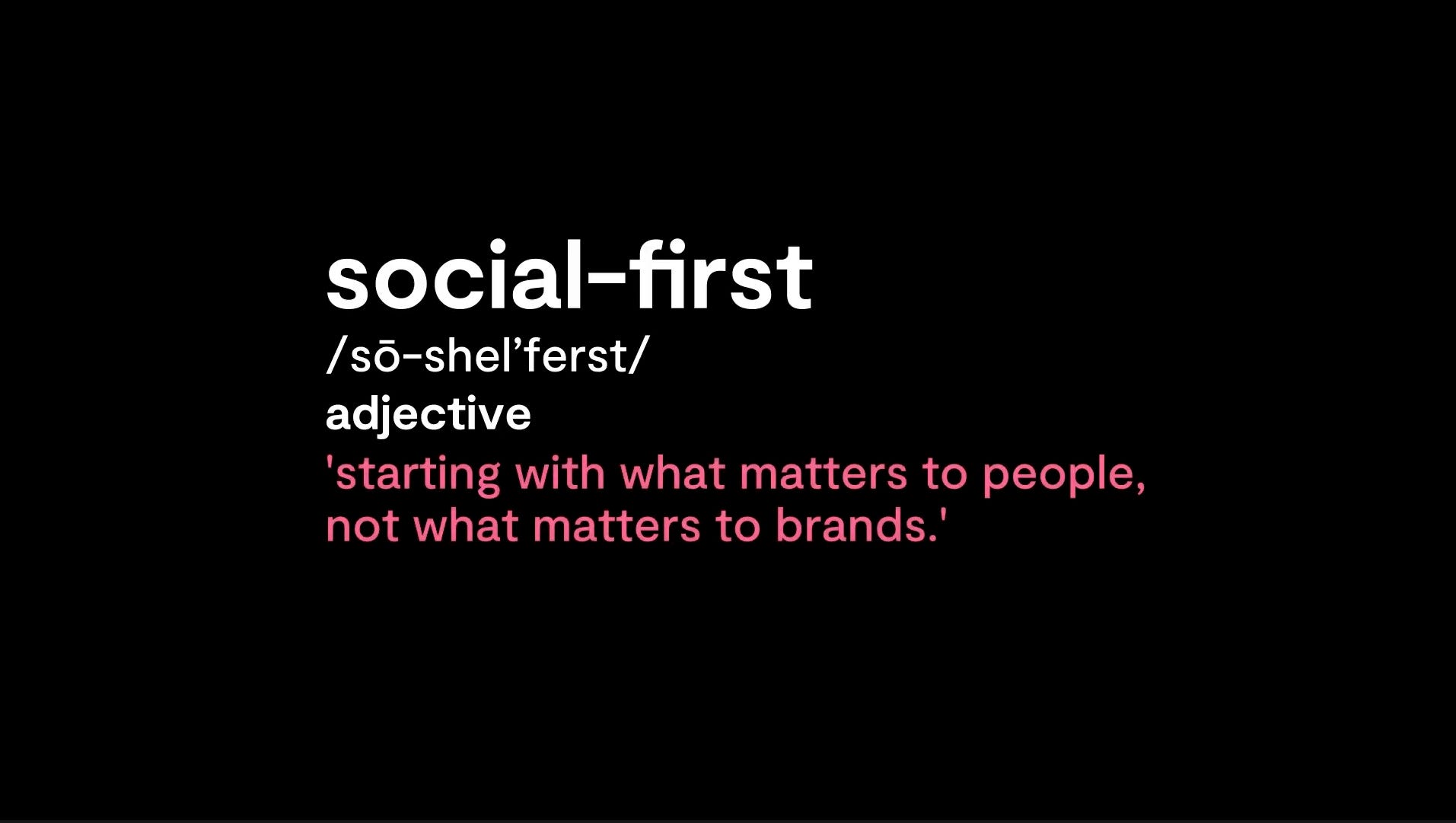
We wrote this manifesto because ‘social-first’ has become empty jargon - and empty jargon is useless. Time to refill it with meaning.
Social-first stopped being a format years ago.
It’s not about dumping content onto social.
It’s about building with social.
Not as a channel. But as the primary space where culture happens.
Sounds obvious, right? Yet we still walk into rooms where social is the last budget line and ‘we’ll adapt for Instagram’ passes for strategy.
Here’s what social-first really means to us, and why it’s never been more essential.
1. Culture starts here. Your brand should too.
Deloitte’s 2025 State of Social report found that 61% of marketers still treat social as a distribution channel.
Only 39% treat it as a place to build ideas from scratch and raise into other channels from there.
That’s the mindset gap. Most marketers are still working upstream: developing ideas for TV, OOH, or press, and asking social to “make it work.”
But people don’t live in TVCs anymore. They live in their smaller screens: scrolling and swiping.
The best brands know that social is where they should start.
2. Attention isn’t free and it’s moving fast
The feed is louder, faster, and more ruthless than ever.
To earn attention, you have to understand what makes someone stop, watch, comment, share. And then build for that.
Hootsuite reports that short-form video is the most effective content type for social ROI, and yet most brands are still repurposing hero assets instead of crafting content native to the feed.
If paid dollars are propping it up, it probably wasn’t built for the feed.
If your audience wouldn’t choose to engage, it's definitely not working.
03. The algorithm isn’t the antagonist, irrelevance is.
Hard truth: if the algorithm shrugs at you, it’s because your content ignored the audience.
From Ogilvy’s 2025 report:
“Brands over-index on trend participation and under-index on cultural relevance. The algorithm rewards connection, not just activity.”
Being social-first means understanding:
What’s resonating right now
Why people engage (and why they scroll past)
The unwritten rules of each platform: from in-jokes to pacing to language
And then creating work that doesn’t just exist in that world, but thrives in it.
4. Creator-first is social-first, but most brands still don’t get it
We should all know that Influencer budgets are exploding. So now what matters is how you use them.
Deloitte found that high-maturity brands see 84–87% ROI from creators, while low-maturity brands lag at 48%. This is due to most brands treating creators like ad space, instead of collaborators.
Being social-first means co-creating with creators, not handing them an AI-written script and a brand-police checklist.
The closer a creator is to their community, the more organically your brand earns relevance.
5. Community is where long-term value lives
Today, a brand’s most valuable ‘assets’ aren’t files, they’re comment threads, duets, stitches: moments shared and remixed.
Deloitte again: Top-performing brands now allocate 24% of their social budget to community and creator engagement. Note a big emphasis on engagement here, as it goes beyond asking for a post and liking a comment.
In a social world, audiences don’t just consume, they co-author. That’s the good stuff.
So what is a social-first brand?
It's one that understands the feed is where everything starts: it’s where people gather today, it’s where people share, and where people are honest and open.
Social-first means:
Ideas that are born in social, not adapted for it
Creators and communities at the heart of how you show up
Cultural fluency as the anchor for every brief
Speed, instinct, and responsiveness over perfection
Measuring relevance, not just reach
Why we made the manifesto
Because we’re tired of hearing ‘social-first’ while seeing work that proves the opposite.
Because some briefs still land with social as a tickbox instead of a foundation.
Because we’ve sat in too many rooms where being relevant was neglected over going viral.
So we’re planting a flag. Right here.
A (60 second) rally cry for sharper creativity, smarter strategy, and brands that can instantly prove they belong in the conversation.
TL;DR?
If your content wouldn’t stop you in the scroll, it’s not social-first.
If it doesn’t move like culture, speak like people, or spark a reaction, you need to go back to the drawing board feed.
This is what social-first really means.
And it’s about time we all stopped pretending we already knew.
If you’re ready to be challenged to start with what matters to people, not your brand, let’s talk.